


Government Contracting | Provice LLC
Winning a government contract can open the door to new customers, long-term business relationships, and opportunities for growth. However, many small businesses struggle to enter the government marketplace—not because they lack the capabilities, but because they don’t know where to begin.
Government contracting involves more than registering your company, finding an opportunity, and submitting a proposal. It requires understanding government purchasing processes, identifying the right opportunities, meeting compliance requirements, preparing competitive bids, and having the operational capacity to deliver.
The good news? Small businesses don’t need to be large government contractors to participate.
Whether you operate an IT company, staffing agency, security business, construction firm, healthcare organization, or professional services company, there may be federal, state, or local contracting opportunities that match your capabilities.
This guide explains how to get government contracts step by step, including the registrations, research, bidding strategies, and preparation needed to compete effectively.
Quick Answer: How Do You Get Government Contracts?
To get government contracts, a small business should identify what it can sell to government agencies, research potential buyers, complete required vendor registrations, select appropriate NAICS codes, evaluate relevant certifications, find qualified opportunities, prepare compliant proposals, and submit competitive bids.
For federal prime contracting, registration in the System for Award Management (SAM.gov) is generally required when submitting an offer, subject to limited exceptions.
The basic process includes:
- Assess your business’s government contracting readiness.
- Identify relevant NAICS codes and government buyers.
- Register your business in SAM.gov and other applicable vendor portals.
- Determine whether small-business certifications could benefit your company.
- Develop a government-focused capability statement.
- Research agencies, previous awards, and potential opportunities.
- Find contracts matching your experience and delivery capabilities.
- Make informed bid/no-bid decisions.
- Prepare compliant, competitive proposals.
- Build government and prime-contractor relationships.
- Submit bids, manage follow-ups, and prepare for contract delivery.
Each step matters. Missing a mandatory requirement or pursuing contracts beyond your capabilities can undermine an otherwise promising opportunity.
Step 1: Determine Whether Your Business Is Ready for Government Contracting
Before searching for government contracts, evaluate whether your company is prepared to deliver the products or services government buyers need.
Government agencies purchase a wide range of goods and services, including information technology, cybersecurity, administrative support, staffing, construction, security, transportation, healthcare, and consulting.
But having a service to sell is only the starting point.
Ask yourself these questions:
- What products or services does our business deliver best?
- Have we successfully completed comparable commercial or government projects?
- Do we have the employees, equipment, and resources to perform a contract?
- Can we handle the financial requirements associated with contract performance?
- Do we have the licenses, insurance, and certifications required for our industry?
- Can our team manage government reporting and administrative obligations?
- Do we have the capacity to prepare proposals without disrupting current operations?
A business doesn’t necessarily need previous federal contract awards to begin competing. However, it must be able to demonstrate relevant capabilities and meet solicitation requirements.
For example, a staffing company may have extensive experience supplying administrative professionals to private-sector clients. That experience may help establish its capabilities for certain government staffing opportunities, although specific solicitations may require additional qualifications or government past performance.
Practical tip: Start with the products or services your company already delivers successfully. Expanding into unfamiliar work simply because a solicitation has a large estimated value creates unnecessary risk.
Step 2: Identify the Right NAICS Codes for Your Business
The North American Industry Classification System (NAICS) categorizes businesses according to their economic activities.
Government agencies use NAICS codes when classifying federal contracting opportunities and determining applicable small-business size standards.
Choosing relevant NAICS codes helps you understand which government markets fit your services.
For example:
| Business type | Example NAICS code |
| IT Consulting | 541512 — Computer Systems Design Services |
| Temporary Staffing | 561320 — Temporary Help Services |
| Security Guards | 561612 — Security Guards and Patrol Services |
| Administrative Support | 561110 — Office Administrative Services |
| Management Consulting | 541611 — Administrative Management and General Management Consulting Services |
| Commercial Construction | 236220 — Commercial and Institutional Building Construction |
These are examples, not an exhaustive classification of each industry. Your actual business activities and the work required under a solicitation determine which codes are relevant.
Why NAICS codes matter
NAICS codes can influence:
- How your business is categorized in SAM.gov.
- Which federal opportunities appear in your searches.
- Applicable small-business size standards.
- Certain certification and eligibility considerations.
- How government buyers and potential partners discover your company.
A company can identify multiple NAICS codes when they accurately reflect its activities.
However, adding dozens of unrelated codes does not make a company more qualified.
Practical tip: Identify a primary NAICS code that reflects your core business and supporting codes that accurately represent additional services.
You can research classifications through the U.S. Census NAICS website and small-business eligibility through the SBA.
Step 3: Register Your Business in SAM.gov
If you want to compete for federal prime contracts, SAM.gov is one of the most important starting points.
The System for Award Management is the federal government’s centralized platform for entity registration and contract opportunity discovery.
What do you need for SAM.gov registration?
Depending on your company’s circumstances, registration may require:
- Legal business name.
- Physical business address.
- Entity validation information.
- Taxpayer information.
- Banking information for applicable payments.
- NAICS codes.
- Business ownership and organizational details.
- Required representations and certifications.
- Points of contact.
During the registration process, your entity receives a Unique Entity ID (UEI).
Depending on the entity and registration requirements, a CAGE code may also be assigned or validated.
Is SAM.gov registration free?
Yes. SAM.gov entity registration is free.
You do not need to pay the federal government or a third-party provider to register. However, businesses sometimes hire outside support to help prepare information, complete registration steps, or manage renewals.
How long does SAM.gov registration take?
Processing times can vary depending on entity validation, submitted information, and whether additional review is necessary.
SAM.gov advises that registration can take up to 10 business days to become active. Businesses should allow additional time for potential validation issues.
Does SAM.gov registration expire?
SAM.gov registrations must be renewed every 365 days to remain active.
For most federal solicitations, companies must already have active SAM registration when submitting an offer, subject to exceptions under the Federal Acquisition Regulation.
Common mistake: Waiting until an attractive opportunity appears before beginning registration.
Practical tip: Complete your registration early and maintain accurate information rather than rushing through the process near a proposal deadline.
Official resource: SAM.gov Entity Registration.
Step 4: Understand Government Contracting Certifications
Small-business certifications can help qualified companies compete for certain contracts reserved for specific business categories.
However, not every company needs every certification, and certification does not guarantee an award.
Some major federal contracting programs include:
8(a) Business Development Program
The SBA 8(a) Business Development Program assists eligible socially and economically disadvantaged small businesses in participating in federal contracting.
Participation requires meeting the program’s current eligibility and certification requirements.
Women-Owned Small Business (WOSB)
The WOSB Federal Contract Program allows eligible certified businesses to compete for certain federal contracts set aside for women-owned small businesses.
HUBZone
The HUBZone program supports qualifying small businesses located in historically underutilized business zones and meeting applicable employment and other requirements.
Veteran Small Business Certification
SBA certification programs support eligible veteran-owned and service-disabled veteran-owned small businesses.
Service-disabled veteran-owned small businesses may qualify for specific federal set-aside opportunities, subject to program requirements.
State and local certifications
Additional certification programs may include:
- Minority Business Enterprise (MBE).
- Women Business Enterprise (WBE).
- Minority- and Women-Owned Business Enterprise (MWBE).
- Disadvantaged Business Enterprise (DBE).
- Small Business Enterprise (SBE).
- State-specific veteran or disabled veteran business certifications.
These programs have different eligibility rules, jurisdictions, and procurement applications.
Important: Federal SBA certifications and state or local supplier-diversity certifications are not interchangeable.
For example, a business holding a city-level MWBE certification does not automatically qualify for a federal WOSB set-aside.
Before applying, research which agencies buy your services and which certification programs are relevant to those opportunities.
Official resource: SBA Certifications and Contracting Programs.
Step 5: Create a Government-Focused Capability Statement
A capability statement is a concise business document used to introduce your company to government buyers, prime contractors, and potential teaming partners.
Think of it as a focused introduction to what your business can deliver.
A professional capability statement typically includes:
Core competencies: The products or services your company provides.
Differentiators: Specific capabilities, resources, qualifications, or experience that distinguish your business.
Past performance: Relevant contracts, projects, clients, or completed work that demonstrate your experience.
Company information: Business name, website, contact information, UEI, CAGE code if applicable, and relevant NAICS codes.
Certifications: Applicable and currently valid business certifications.
What makes a strong capability statement?
A strong capability statement is relevant to the prospective buyer.
For example, a cybersecurity firm’s statement should explain its relevant technical services, delivery experience, and qualifications rather than simply describing itself as a technology company.
Similarly, a security business approaching a government facilities department should emphasize relevant security services, operational capacity, licensing, and comparable experience.
Practical tip: Consider tailoring your capability statement to the agency or prime contractor you are approaching.
A capability statement is not a replacement for a formal proposal. Its purpose is to communicate your company’s fit and create opportunities for further discussion.
Step 6: Research Which Government Agencies Buy Your Services
One of the biggest mistakes new government contractors make is searching for open bids before understanding the market.
A better approach begins with researching who buys your services.
Suppose you operate an IT staffing company.
Instead of searching for every contract containing the word “staffing,” research:
- Which agencies regularly purchase IT staffing services?
- What types of positions do they need?
- How frequently do they issue contracts?
- What contract vehicles do they use?
- Which companies have received similar awards?
- Do they frequently use small-business set-asides?
- Are opportunities primarily awarded directly or through existing prime contractors?
Where can you research government buying history?
USAspending.gov
The federal spending database allows users to research historical awards, recipients, agencies, and contract information.
Website: https://www.usaspending.gov/
SAM.gov
Search active federal contracting opportunities and related procurement notices.
Website: https://sam.gov/
Agency procurement forecasts
Some federal agencies publish anticipated contracting requirements that help businesses prepare before formal solicitations appear.
State and local procurement portals
State agencies, counties, cities, school districts, public authorities, and other government entities may maintain their own procurement websites.
Practical tip: Create a target list of agencies purchasing your exact services, then study their previous procurement activity.
This is more useful than responding randomly to every solicitation that appears in a keyword search.
Step 7: Find Government Contracts That Match Your Business
Once your company has completed its initial preparation, it’s time to develop an opportunity pipeline.
There are three major markets to consider.
Federal government contracts
Federal opportunities are posted through SAM.gov and other authorized acquisition channels.
Potential opportunities include:
- Requests for Proposals (RFPs).
- Requests for Quotations (RFQs).
- Invitations for Bids (IFBs).
- Sources Sought notices.
- Requests for Information (RFIs).
- Agency-specific procurement notices.
Not all of these are requests for binding bids. Sources Sought notices and RFIs, for example, are often market research tools.
State government contracts
State agencies issue solicitations for services such as IT, healthcare, staffing, facilities, construction, and professional consulting.
Registration and submission requirements differ by state.
Local government contracts
Cities, counties, public schools, municipalities, and special districts purchase a wide variety of goods and services.
Local government opportunities can be valuable for companies with relevant geographical coverage and operational capacity.
How should you filter opportunities?
Instead of using broad keywords alone, consider:
| Filter | What to evaluate |
| Service fit | Does the scope match what your company actually delivers? |
| Location | Can you perform the work where required? |
| NAICS | Does the opportunity align with your services and eligibility? |
| Set-aside | Is your business eligible to compete? |
| Experience | Do you meet the past performance requirements? |
| Licenses | Do you possess the required licenses and qualifications? |
| Capacity | Can your team deliver the contract? |
| Budget | Can you price the work competitively and sustainably? |
| Deadline | Is there sufficient time to prepare a compliant response? |
Important: Finding more bids does not necessarily mean finding more business opportunities.
A focused pipeline of relevant solicitations is more useful than hundreds of opportunities your company cannot realistically pursue.
This is why businesses should establish clear opportunity qualification criteria before committing resources to proposal development.
Step 8: Make a Bid/No-Bid Decision Before Preparing a Proposal
Not every government contract is worth pursuing.
A bid/no-bid review helps determine whether a particular opportunity deserves your company’s time, effort, and financial resources.
Before deciding to bid, assess five important areas.
1. Eligibility
Does the company meet all mandatory eligibility requirements?
Check business registrations, set-asides, certifications, location restrictions, mandatory licenses, and other minimum qualifications.
2. Technical capability
Can the company perform every required service?
Review staffing requirements, equipment, performance standards, deliverables, and timelines.
3. Past performance
Does the solicitation require previous projects of a certain size, scope, or type?
Can your company demonstrate sufficiently relevant experience?
4. Financial feasibility
Can you develop pricing that covers labor, benefits, insurance, overhead, subcontractors, equipment, administrative costs, and an appropriate margin?
A contract can generate revenue while still being financially unattractive.
5. Competitive position
Does your company have a credible reason to win?
Consider incumbent contractors, past purchasing patterns, delivery strengths, potential teaming partners, and evaluation criteria.
Example: When should a company avoid bidding?
Imagine a small staffing agency finds a large statewide solicitation requiring hundreds of qualified employees to begin work within a short mobilization period.
The company may be legally eligible to respond, but if it lacks recruiting capacity, available personnel, working capital, and operational infrastructure, pursuing the contract could create substantial delivery risk.
A smaller opportunity that fits its capabilities may be a more sensible target.
Practical tip: Document bid/no-bid decisions in a consistent format so your team can learn which opportunities align with your strengths.
Step 9: Prepare a Compliant and Competitive Government Proposal
Once you identify a suitable solicitation, the next challenge is preparing the response.
Government proposal preparation is not simply writing a convincing company introduction.
The proposal must follow the solicitation’s instructions and address the buyer’s stated requirements.
Start with the complete solicitation package
Review:
- Main solicitation documents.
- Statement of Work or Performance Work Statement.
- Submission instructions.
- Evaluation criteria.
- Pricing schedules.
- Required forms and certifications.
- Contract terms and conditions.
- Attachments.
- Amendments and clarifications.
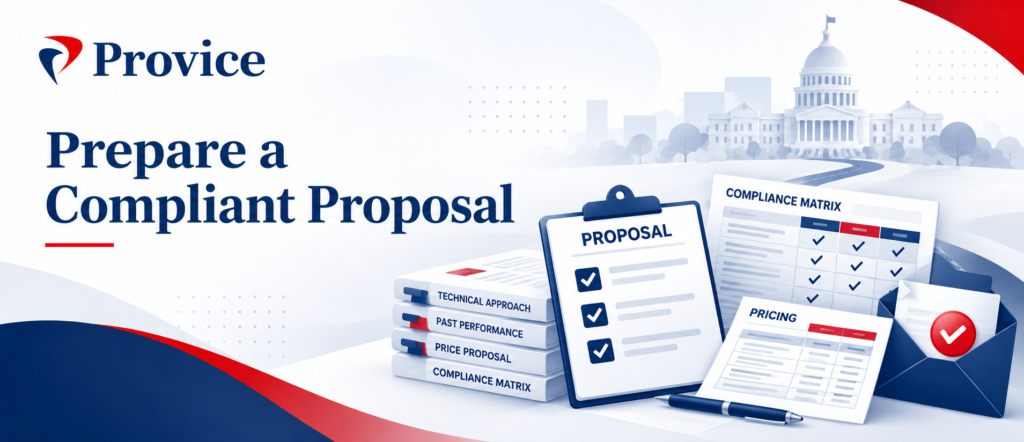
Develop a compliance matrix
A compliance matrix connects solicitation requirements to the sections and supporting documents in your response.
For example:
| Solicitation requirement | Proposal response |
| Company qualifications | Corporate experience section |
| Staffing plan | Technical approach |
| Past performance references | Past performance section |
| Labor rates | Pricing schedule |
| Proof of insurance | Required supporting attachment |
| Signed certifications | Administrative forms |
A compliance matrix helps your team track each requirement and identify missing responses before submission.
Write to the evaluation criteria
If the government evaluates technical approach, staffing, experience, and price, your proposal should clearly address those elements.
Avoid inserting large amounts of unrelated company history.
Focus on how your organization will fulfill the requirements.
Develop realistic pricing
Your price should reflect the actual cost of delivering the work.
For labor-intensive contracts, consider:
- Base wages and salaries.
- Payroll taxes and benefits.
- Overtime or shift differentials.
- Applicable prevailing wage requirements.
- Recruiting and onboarding.
- Supervision.
- Insurance.
- Equipment and supplies.
- Travel, if required.
- Overhead and administrative costs.
- Profit margin.
Always use the pricing format required by the solicitation.
Check amendments before submission
Government buyers may modify requirements, deadlines, specifications, or pricing instructions through formal amendments.
Your team must review applicable changes and acknowledge amendments when required.
Perform a final compliance review
Before submitting, verify that:
- Every mandatory section is complete.
- Required forms are signed.
- Pricing tables are accurate.
- Supporting documents are included.
- Page limits and formatting instructions are followed.
- Amendments have been incorporated.
- The response is submitted through the correct method before the deadline.
Practical tip: Allow time for final review rather than finishing the proposal immediately before the submission deadline.
A technically strong response can still fail if it misses mandatory submission requirements.
Step 10: Consider Subcontracting as a Route Into Government Contracting
Your first government contracting opportunity does not necessarily need to be a direct contract with a government agency.
Subcontracting allows a business to perform part of a government contract under a prime contractor.
For some small businesses, this can be an effective way to enter the market, build relationships, and develop relevant experience.
What is the difference between a prime contractor and a subcontractor?
A prime contractor holds the contract directly with the government and is responsible for fulfilling its obligations.
A subcontractor performs an agreed portion of the work for the prime contractor under a separate subcontract.
For example, a large government IT contractor may need specialized cybersecurity professionals, technical recruiters, software developers, or project support.
A smaller company with relevant capabilities may be able to support the prime contractor.
How do you find prime contractors?
Start by researching companies that have already received contracts in your industry.
Then identify:
- Their government customers.
- The services they provide.
- Current and upcoming contracts.
- Relevant supplier diversity or subcontracting programs.
- Potential gaps your company could address.
Prepare a capability statement and targeted introduction showing how your company could support their work.
The SBA also provides information about subcontracting opportunities and the Small Business Search system.
Official resource: SBA Prime and Subcontracting.
Practical tip: Do not approach prime contractors with only a generic request for opportunities. Explain the specific services, resources, experience, or geographic coverage your company can contribute.
Step 11: Build Relationships Before Opportunities Are Released
Government contracting is not exclusively a bidding activity.
Successful business development also involves understanding buyers, maintaining accurate company information, responding to market research, and developing relationships with potential partners.
Depending on your target market, relationship-building activities may include:
- Attending government procurement outreach events.
- Participating in agency industry days.
- Connecting with small-business specialists.
- Responding to Sources Sought notices.
- Introducing your company to relevant procurement teams.
- Building relationships with prime contractors.
- Monitoring upcoming procurement forecasts.
- Maintaining accurate capability and vendor profiles.
The purpose is not to seek special treatment.
It is to understand purchasing requirements, communicate legitimate capabilities, and prepare for opportunities through appropriate procurement channels.
Strong market research and early preparation can improve the quality of future bid decisions.
Step 12: Prepare for Contract Delivery Before You Win
Many new government contractors concentrate almost entirely on proposal submission.
However, winning the contract is not the end of the process.
It marks the beginning of a new operational responsibility.
Before submitting a proposal, consider how your company will handle:
Contract kickoff: How will responsibilities, schedules, and deliverables be established?
Staffing: Can employees and subcontractors be mobilized on time?
Compliance: Who will monitor contractual obligations, applicable rules, and required documentation?
Reporting: How will progress, deliverables, and performance be reported?
Financial management: Can the company support payroll and other expenses while following contract invoicing and payment procedures?
Communication: Who will manage communication with authorized government representatives?
Performance management: How will your team address service quality, delays, and corrective actions?
A company that cannot deliver the contract successfully may face significant financial, operational, and contractual consequences.
Practical tip: Build a basic post-award execution plan during the bid stage. Doing so helps validate your pricing, staffing assumptions, and delivery capacity.
Common Mistakes Small Businesses Make When Pursuing Government Contracts
Understanding what to avoid is just as important as knowing where to begin.
Mistake 1: Assuming SAM.gov registration brings contracts automatically
Registration establishes an important foundation, but it does not replace market research, opportunity sourcing, proposal development, or business development.
Mistake 2: Bidding on everything
A high volume of poorly matched submissions can consume resources without creating a sustainable pipeline.
Mistake 3: Ignoring past performance requirements
Relevant experience matters. Businesses should review each solicitation’s evaluation and qualification requirements rather than assuming all opportunities accept the same references.
Mistake 4: Focusing only on certifications
Certifications can create access to certain opportunities, but customers still evaluate the applicable qualifications, technical requirements, and offer terms.
Mistake 5: Underpricing
Winning a contract at a price that cannot support delivery may create serious financial problems.
Mistake 6: Missing administrative requirements
Unsigned forms, missing attachments, incorrect submission methods, and overlooked amendments can jeopardize an otherwise competitive proposal.
Mistake 7: Neglecting subcontracting
Companies that focus exclusively on prime contracts may overlook opportunities to build experience and relationships by supporting established government contractors.
Mistake 8: Failing to prepare for contract performance
Staffing, compliance, reporting, and project delivery should be evaluated before the bid is submitted.
Government Contracting Readiness Checklist
Before pursuing your next opportunity, use this checklist to evaluate your company’s preparation.
| Readiness item | What to confirm |
| Business capabilities | Products and services clearly defined |
| Target buyers | Relevant federal, state, or local agencies identified |
| NAICS codes | Codes accurately reflect services |
| Vendor registration | Required registrations active |
| Certifications | Relevant eligibility assessed |
| Capability statement | Professional and up to date |
| Past performance | Relevant projects documented |
| Opportunity sourcing | Repeatable search process established |
| Bid qualification | Bid/no-bid framework available |
| Proposal preparation | Requirements tracking process established |
| Pricing | Costs and delivery assumptions validated |
| Teaming | Potential partners identified |
| Submission controls | Deadlines and mandatory forms tracked |
| Contract delivery | Staffing, reporting, and operations planned |
If several of these elements are missing, improving your readiness before aggressively pursuing bids may save significant time and resources.
Frequently Asked Questions About Getting Government Contracts
Can a new business get government contracts?
Yes. A new business can pursue government contracts if it meets the applicable eligibility, technical, financial, and solicitation-specific requirements. Some opportunities require particular past performance or experience, while others may provide different ways to demonstrate capability.
Do you need previous government contracts to win your first one?
Not always. Some solicitations may allow relevant commercial project experience or evaluate companies without government past performance differently. Requirements vary by procurement, so reviewing the evaluation criteria is essential.
Is government contracting only for large companies?
No. Federal, state, and local government agencies purchase products and services from businesses of different sizes. Certain federal opportunities are also reserved for qualifying small businesses.
Do you need an LLC to get government contracts?
Not necessarily. The required legal business structure depends on applicable laws, registration requirements, and the specific procurement. An LLC is not a universal federal contracting requirement.
How much does it cost to register on SAM.gov?
SAM.gov entity registration is free. Optional professional assistance may involve service fees, but no third party is required to complete registration.
How long does it take to win a government contract?
There is no standard timeline. Registration, market research, solicitation periods, evaluation, award decisions, and potential delays all affect the process. Some opportunities move relatively quickly, while more complex procurements can take many months.
Can you win a government contract without certifications?
Yes. Not every government contract requires a socioeconomic business certification. However, specific set-aside opportunities require qualifying business status and, where applicable, certification.
Where can small businesses find government contracts?
Federal opportunities can be found through SAM.gov. State and local agencies use their respective procurement portals and other purchasing systems. Historical federal contract data can be researched through USAspending.gov.
What is the easiest way to start government contracting?
A practical starting point is to focus on services your company already delivers well, identify government buyers purchasing those services, complete required registrations, and pursue appropriately sized opportunities. Subcontracting may also provide a useful entry route.
Can someone help my business prepare government bids?
Yes. Businesses can seek assistance with opportunity research, bid qualification, compliance reviews, proposal development, pricing coordination, and submission preparation. SBA-supported APEX Accelerators also offer government contracting assistance, often at no cost.
Getting Started With Government Contracting: Build a Process, Not Just a Registration
Government contracting can create meaningful growth opportunities for small businesses, but the process requires patience, preparation, and disciplined execution.
Registering in SAM.gov is important. Finding relevant contracts matters. Preparing competitive proposals is essential.
But these activities work best as parts of a coordinated system.
A business that understands its target buyers, qualifies opportunities carefully, maintains compliance, manages proposals effectively, and prepares for delivery is better positioned to compete sustainably.
The goal should not simply be to submit more bids.
The goal should be to pursue the right contracts, prepare stronger responses, and build the operational capacity to perform successfully.
Ready to Enter Government Contracting? Start With Provice GovCon Jumpstart
Getting started in government contracting can feel overwhelming when you are managing registrations, certifications, opportunity searches, and proposal requirements while also running your business.
Provice LLC helps small and growing businesses build the foundation needed to enter and pursue government contracting opportunities.
Our GovCon Jumpstart solution brings together the essential components of government contracting preparation.
Depending on your business’s needs, support may include:
- Government contracting readiness assessment.
- SAM.gov registration and UEI support.
- NAICS code identification.
- Relevant certification guidance.
- Federal, state, and local vendor registrations.
- Capability positioning.
- Government opportunity sourcing.
- Initial bid and proposal support.
Unlike an advice-only engagement, Provice is built around execution. We work alongside businesses to help organize the systems, information, and activities needed to move forward.
Whether you’re preparing to pursue your first government contract or building a more structured contracting pipeline, a clear foundation can make the process easier to manage.
Your Business. Our Execution.
Explore GovCon Jumpstart and connect with Provice LLC to discuss your government contracting goals.
Website: www.provicellc.com
Official Government Resources
For additional information, consult these government sources:
- U.S. Small Business Administration — Getting Started With Contracting
- SAM.gov — Registration and Federal Opportunities
- SBA — Business Certifications
- SBA — Prime and Subcontracting
- USAspending.gov — Federal Award Data
- Acquisition.gov — Federal Acquisition Regulation
Disclaimer: This article provides general educational information about U.S. government contracting. Registration, eligibility, certification, acquisition, and submission requirements may change and may vary by agency and solicitation. Always review the latest official guidance and specific solicitation requirements before taking action.