


Government Contracting | Provice LLC | Updated October 2026
Your company is registered. You’ve searched for government opportunities. Maybe you’ve even identified a promising Request for Proposal (RFP).
But here’s the question many small businesses overlook:
Is your business actually ready to compete for—and successfully deliver—a government contract?
Getting started in government contracting involves more than completing SAM.gov registration or finding a solicitation that matches your industry.
Government buyers may evaluate your qualifications, experience, technical capabilities, pricing, compliance, and ability to perform the work. Even an attractive opportunity can become a costly distraction if your business is not prepared.
That’s why assessing your readiness before investing time and resources in proposals is an important step.
This 15-point government contracting readiness checklist will help you identify what your company already has in place, where gaps may exist, and what to prioritize before pursuing federal, state, or local government contracts.
What Does It Mean to Be Government Contracting Ready?
Government contracting readiness means having the legal eligibility, relevant capabilities, resources, business processes, and operational capacity needed to pursue suitable government opportunities and fulfill the resulting contractual obligations.
Being ready doesn’t necessarily mean having years of government contracting experience or every available business certification.
It means understanding what government customers purchase, where your business fits, what requirements apply, and whether you can submit a competitive, compliant offer.
A company may be ready for a small local contract but not a complex federal project. Readiness is therefore both business-specific and opportunity-specific.
The following checklist covers five essential areas:
- Business foundation and registrations.
- Market positioning and qualifications.
- Opportunity sourcing and bid strategy.
- Proposal and financial readiness.
- Contract execution and operational capacity.
Important: This is a business planning assessment, not an official government certification or eligibility determination. Certain requirements are mandatory only for particular procurements, while other items represent recommended business practices.
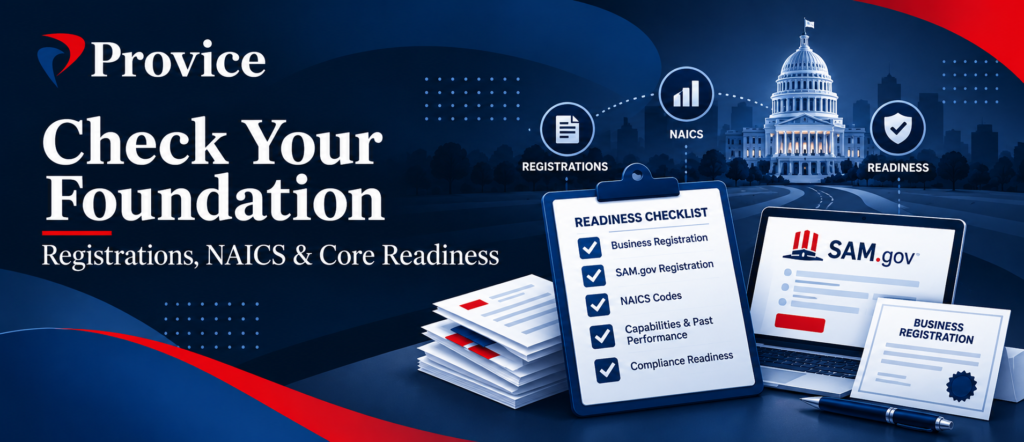
Part 1: Business Foundation and Registrations
1. Your Business Is Legally Established and Properly Registered
Before pursuing government work, confirm that your company is legally established and authorized to provide the services it intends to sell.
Readiness checklist:
- Our legal business information is current and accurate.
- We have the business licenses and permits applicable to our operations.
- We understand any geographic or professional licensing requirements relevant to our target contracts.
For example, a security services company may need jurisdiction-specific security licenses, while a construction company may require contractor licensing and project-specific qualifications.
Federal, state, and local purchasing entities may impose different registration and licensing conditions.
Why it matters: Legal and licensing deficiencies can prevent participation or contract performance, even if your company has the technical resources to complete the work.
2. Your SAM.gov and Vendor Registrations Are Ready
For most federal prime contracting opportunities, businesses must maintain an active registration in the System for Award Management (SAM.gov), subject to applicable exceptions.
SAM.gov assigns a Unique Entity ID (UEI) and maintains important company information and federal representations and certifications.
Readiness checklist:
- Our SAM.gov registration is active, or we have a clear plan to complete it before pursuing opportunities requiring it.
- Our UEI and other applicable registration identifiers are accurate.
- We have registered with relevant state or local procurement portals when required.
SAM.gov registration is free and must be renewed every 365 days to remain active.
Why it matters: Having a company profile or UEI alone does not necessarily mean your federal contract registration is active.
Official resource: SAM.gov Entity Registration
3. You Have Identified the Right NAICS Codes
North American Industry Classification System (NAICS) codes help categorize business activities.
Federal agencies use NAICS codes to classify procurements and apply relevant size standards.
Readiness checklist:
- Our primary NAICS code accurately reflects our main business activity.
- We have identified relevant secondary NAICS codes.
- We understand which codes apply to the government opportunities we’re targeting.
For example, an IT business may need to distinguish between software development, computer systems design, cybersecurity consulting, and IT staffing.
Why it matters: Inaccurate classification can complicate market research and create confusion around applicable small-business eligibility.
Part 2: Market Positioning and Qualifications
4. You Know Which Government Agencies Buy Your Services
Before submitting bids, determine whether government agencies actually purchase the products or services your company provides.
Readiness checklist:
- We have identified agencies that purchase our products or services.
- We have researched previous contract awards or relevant procurement forecasts.
- We understand whether our best opportunities are federal, state, or local.
For example, a staffing firm specializing in healthcare professionals should research agencies and public institutions that regularly procure those services rather than monitor every general staffing opportunity.
Tools such as USAspending.gov and SAM.gov can help with federal market research.
Why it matters: Government contracting becomes more manageable when you know your target buyers instead of reacting to every new solicitation.
5. You Have Relevant Past Performance or Demonstrable Experience
Past performance can play an important role in proposal evaluation.
However, businesses do not always need previous federal contract awards to compete. Depending on the solicitation, relevant commercial projects, subcontracting experience, or other qualifications may be considered.
Readiness checklist:
- We can identify completed projects relevant to our target contracts.
- We have documentation supporting project scope, dates, and results.
- We can provide references when required.
For example, a staffing company that has successfully supported large private-sector clients may be able to demonstrate relevant recruitment and workforce management capabilities.
The key is whether the experience meets the particular solicitation’s requirements.
Why it matters: Buyers need credible evidence that your business can perform the requested work.
6. Your Capability Statement Is Current and Targeted
A capability statement introduces your company to government buyers, prime contractors, and potential teaming partners.
Readiness checklist:
- We have a professional and current capability statement.
- It clearly describes our core competencies and differentiators.
- It includes relevant experience, certifications, and company identifiers.
A strong capability statement should communicate what your business can deliver, not merely describe the company in generic terms.
Why it matters: A targeted capability statement supports business development and helps prospective partners quickly assess your fit.
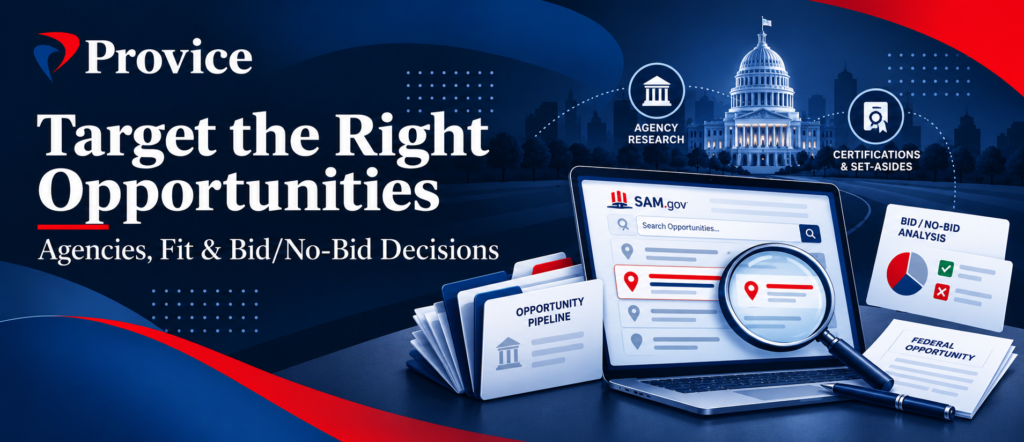
Part 3: Opportunity Sourcing and Bid Strategy
7. You Have a Reliable Process for Finding Government Opportunities
Government opportunities appear across multiple procurement systems.
Searching occasionally or relying on random notifications is not a repeatable business development strategy.
Readiness checklist:
- We regularly monitor appropriate government procurement sources.
- We use relevant keywords, NAICS codes, geography, and eligibility criteria.
- We maintain a list or pipeline of opportunities worth reviewing.
A useful opportunity pipeline should record the agency, scope, deadline, estimated value if available, eligibility requirements, and current pursuit status.
Why it matters: A consistent sourcing process helps you identify opportunities earlier and plan proposal resources more effectively.
8. You Have Defined Bid/No-Bid Criteria
Finding an opportunity doesn’t automatically mean your company should pursue it.
Before committing to a solicitation, evaluate whether it fits your business.
Readiness checklist:
- We review mandatory eligibility requirements before deciding to bid.
- We assess technical, staffing, financial, and geographic fit.
- We consider proposal effort and our competitive position.
For example, a company may be eligible for a large contract but lack the staffing capacity or working capital to perform it successfully.
Why it matters: A disciplined bid/no-bid process can prevent wasted effort and help your team concentrate on realistic opportunities.
9. You Understand Relevant Certifications and Set-Aside Programs
Certain government opportunities are reserved for businesses meeting specific small-business or socioeconomic eligibility requirements.
Depending on your company and target market, relevant programs may include 8(a), WOSB, HUBZone, SDVOSB, MBE, WBE, MWBE, DBE, or SBE.
Readiness checklist:
- We have researched which certification programs apply to our business.
- We understand which opportunities require certification or a particular business status.
- We have a plan to obtain and maintain appropriate certifications when beneficial.
Not every contract requires certification. Federal and state or local programs also have different requirements.
Why it matters: Certifications can provide access to particular contracting opportunities, but they do not automatically make a company competitive or guarantee an award.
Official resource: SBA Certification Programs
Part 4: Proposal and Financial Readiness
10. You Know How to Review and Respond to a Government Solicitation
Government solicitations often contain detailed instructions governing eligibility, proposal content, forms, pricing, and submission.
Readiness checklist:
- We know how to identify mandatory solicitation requirements.
- We understand the required proposal format and evaluation criteria.
- We have a process for tracking amendments, questions, and deadlines.
A proposal should respond directly to the requirements instead of relying on generic company marketing materials.
Why it matters: Missing a mandatory requirement or failing to submit a required document can jeopardize your proposal.
11. You Have a Proposal Preparation and Quality-Control Process
Preparing a government proposal involves coordinating technical information, pricing, references, forms, and administrative documents.
Readiness checklist:
- We have assigned responsibility for proposal preparation and review.
- We use a compliance checklist or matrix to track requirements.
- We allow time for a final quality review before submission.
A compliance matrix can help connect every solicitation requirement to the section or attachment addressing it.
Why it matters: A repeatable proposal process reduces last-minute confusion and makes it easier to manage multiple opportunities.
12. You Understand Your Costs and Financial Capacity
Government contracting can require significant financial planning, especially for staffing, construction, security, healthcare, and other labor-intensive services.
Readiness checklist:
- We can calculate realistic labor, equipment, overhead, and administrative costs.
- We understand applicable wage and benefit obligations.
- We can assess whether cash flow supports contract mobilization and performance.
For example, a security company may need to pay guards, supervisors, payroll taxes, and insurance expenses before receiving payment from the customer.
That gap must be considered before bidding.
Why it matters: Winning a contract at an unsustainable price can create serious financial risk.
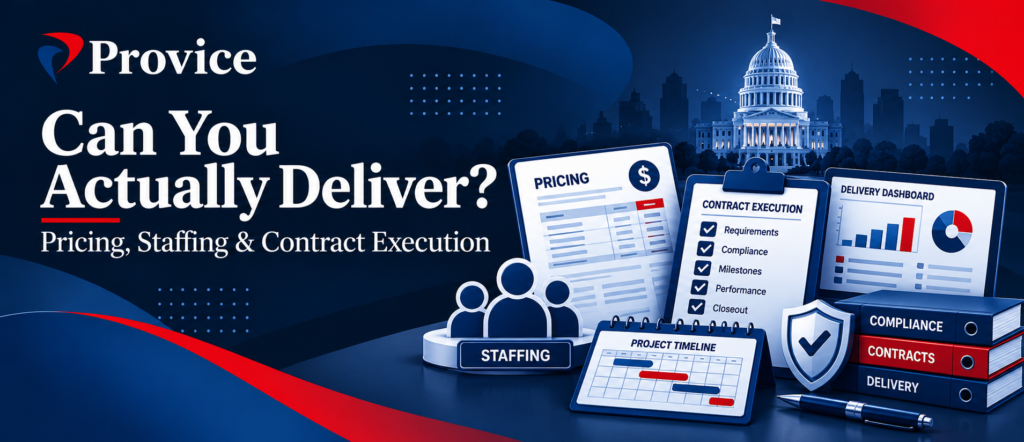
Part 5: Contract Execution and Operational Capacity
13. You Have the Staffing and Resources Needed to Perform
Government buyers expect contractors to perform according to the contract’s requirements.
Readiness checklist:
- We understand the staffing and technical resources our target contracts may require.
- We can recruit, allocate, or subcontract qualified personnel when permitted.
- We have a realistic mobilization plan.
A company does not necessarily need every future employee on payroll before submitting an offer.
However, it must satisfy any requirements for committed personnel and demonstrate a credible delivery plan.
Why it matters: A contract award creates performance obligations—not just a new source of revenue.
14. You Can Manage Contract Administration and Compliance
After award, contractors may be responsible for reporting, documentation, deliverables, certifications, invoicing, subcontractor management, and other contractual obligations.
Readiness checklist:
- We can track contract deadlines, obligations, and deliverables.
- We have an organized process for maintaining contract records.
- We know who will coordinate reporting and authorized customer communications.
Requirements vary by contract, but administrative oversight should not be an afterthought.
Why it matters: Poor documentation and missed contractual obligations can affect performance, payments, and future opportunities.
15. You Have an Organized System for Managing Government Contracting Activities
Government contracting often involves multiple ongoing activities: market research, opportunity sourcing, partnerships, proposals, registrations, compliance, and contract delivery.
Readiness checklist:
- We use a centralized pipeline or tracking system.
- Team members have clear responsibilities and deadlines.
- We have a process for reviewing results and improving performance.
A company may use a spreadsheet initially, while growing contractors may benefit from a CRM, reporting dashboard, task management platform, or workflow automation.
The objective is consistency and visibility.
Why it matters: A repeatable operating system helps businesses manage a growing pipeline without losing control of important details.
How to Evaluate Your Government Contracting Readiness
Use the 15 areas above to conduct a practical self-assessment.
For each area, assign one point if the applicable capability or process is sufficiently established.
| Total score | Suggested interpretation |
| 0–5 points | Foundation stage — focus on registrations, capabilities, target-market research, and basic processes |
| 6–10 points | Developing stage — several elements are in place, but important gaps may remain |
| 11–13 points | Progressing stage — much of the foundation exists; focus on opportunity-specific gaps |
| 14–15 points | Strong preparation — review individual solicitation requirements and delivery capacity before bidding |
These score ranges are Provice’s suggested planning framework, not an official SBA or government qualification standard.
A high score does not override mandatory eligibility, licensing, registration, certification, or solicitation requirements.
Likewise, a lower score does not necessarily mean your business is prohibited from pursuing all government contracts.
The value of the assessment is identifying the next steps.
What Should You Do If Your Business Isn’t Fully Ready?
You don’t need to solve every possible government contracting challenge at once.
Instead, prioritize the gaps most relevant to your business and target opportunities.
If registrations are missing: Establish the required vendor profiles and confirm the registration timelines.
If you haven’t identified buyers: Research historical awards, agency purchasing activity, and relevant procurement forecasts.
If you lack proposal experience: Build a solicitation review, compliance tracking, and quality-control process.
If you lack government past performance: Evaluate opportunities that can consider relevant commercial experience and research suitable subcontracting relationships.
If you’re concerned about delivery capacity: Review staffing, cash flow, subcontractors, reporting, and operational systems before making commitments.
The right preparation depends on what you sell, where you operate, and the contracts you intend to pursue.
Can a Small Business Start Government Contracting Without Being Fully Prepared?
Yes, a business can begin learning about government contracting, researching agencies, and exploring suitable opportunities while building its readiness.
However, pursuing and receiving particular contracts requires meeting applicable registration, qualification, and solicitation requirements.
For some businesses, a logical path may be:
Research → Register → Position → Find Opportunities → Qualify → Bid → Deliver
Others may benefit from starting with subcontracting opportunities or smaller local contracts that better match their current resources.
The goal isn’t to wait until your company is perfect.
It’s to avoid committing to work your business cannot properly qualify for or perform.
Frequently Asked Questions
What is a government contracting readiness assessment?
A government contracting readiness assessment evaluates whether a business has the registrations, qualifications, experience, market knowledge, proposal processes, financial resources, and operational capacity needed to pursue suitable government opportunities.
Do I need SAM.gov registration before bidding?
For most federal prime contracting solicitations, an active SAM.gov registration is required at offer submission and award, subject to specific regulatory exceptions or applicable provisions. State and local procurement systems have their own requirements.
Can a startup qualify for government contracts?
Yes. Startups can pursue opportunities for which they meet the applicable requirements. However, some solicitations impose minimum experience, past performance, financial capacity, or staffing qualifications.
Do I need a government contracting certification?
Not for every opportunity. Certain set-aside programs require specific eligibility or certification, but many contracts do not require socioeconomic certification.
Can commercial experience count as past performance?
It may, depending on the solicitation. Relevant commercial projects can demonstrate capability, but contractors must review each procurement’s specific evaluation and eligibility criteria.
What if my company cannot handle a large contract independently?
Research smaller opportunities, suitable subcontracting roles, or legitimate teaming arrangements, subject to the solicitation and applicable contracting rules.
How do I know which government contracts are right for my business?
Compare each opportunity’s scope, eligibility, experience requirements, location, performance schedule, staffing needs, and financial obligations with your current capabilities.
Ready to Find Out Where Your Business Stands?
Government contracting readiness is not just about having a SAM.gov registration or knowing where to find bids.
It’s about having the right foundation to identify relevant opportunities, prepare compliant proposals, and deliver successfully.
Provice LLC helps small and growing businesses turn government contracting preparation into an organized execution process.
Through a GovCon Readiness Consultation, we can help you review your current position, identify potential gaps, and determine which next steps deserve attention.
For businesses beginning their government contracting journey, our GovCon Jumpstart solution can provide support with:
- Government contracting readiness assessment.
- SAM.gov registration and UEI support.
- NAICS selection and capability positioning.
- Certification and vendor registration assistance.
- Opportunity sourcing and qualification.
- Initial proposal preparation and bid support.
Whether you’re just entering government contracting or trying to build a more structured approach, the objective is the same: pursue the right opportunities with the preparation needed to compete responsibly.
Take the next step toward government contracting readiness.
Request a GovCon Readiness Consultation with Provice LLC.
From First Bid to Full-Scale Delivery.
Official Resources
- SBA — Get Started With Government Contracting
- SAM.gov — Entity Registration
- SBA — Small Business Certifications
- USAspending.gov — Federal Award Data
- Acquisition.gov — Federal Acquisition Regulation
Disclaimer: This checklist is provided for general educational and business-planning purposes. It does not establish government contracting eligibility or guarantee contract awards. Always review current official requirements and individual solicitations before submitting an offer.