

Government Contracting | Provice LLC | Updated November 2026
If you’re starting your government contracting journey, you’ve probably encountered three terms: UEI, CAGE code, and SAM.gov.
They often appear together in registration instructions, federal solicitations, and government contracting forms. But they don’t mean the same thing.
A Unique Entity ID (UEI) identifies your business in federal systems. A Commercial and Government Entity (CAGE) code is a separate identifier used in federal procurement and administration. SAM.gov is the government platform where businesses register to pursue federal awards.
Understanding the difference is important because having a UEI or CAGE code does not automatically mean your business has an active SAM.gov registration or is eligible to submit a particular federal bid.
This guide explains what each term means, how the identifiers are obtained, and what small businesses need before pursuing federal government contracts.
Quick Answer: What’s the Difference Between UEI, CAGE Code, and SAM.gov?
The main difference is simple:
- UEI (Unique Entity ID): A 12-character alphanumeric identifier assigned through SAM.gov that identifies a specific entity.
- CAGE Code (Commercial and Government Entity Code): A five-character alphanumeric code used to identify contractors and support federal procurement and contract administration.
- SAM.gov (System for Award Management): The official U.S. government platform where entities register for federal awards, maintain registration information, and access federal contracting opportunities.
Think of it this way: UEI identifies your entity, CAGE provides another procurement identifier, and SAM.gov is the registration system.
For most federal prime contracting opportunities, businesses need an active SAM.gov registration rather than simply possessing an identifier.
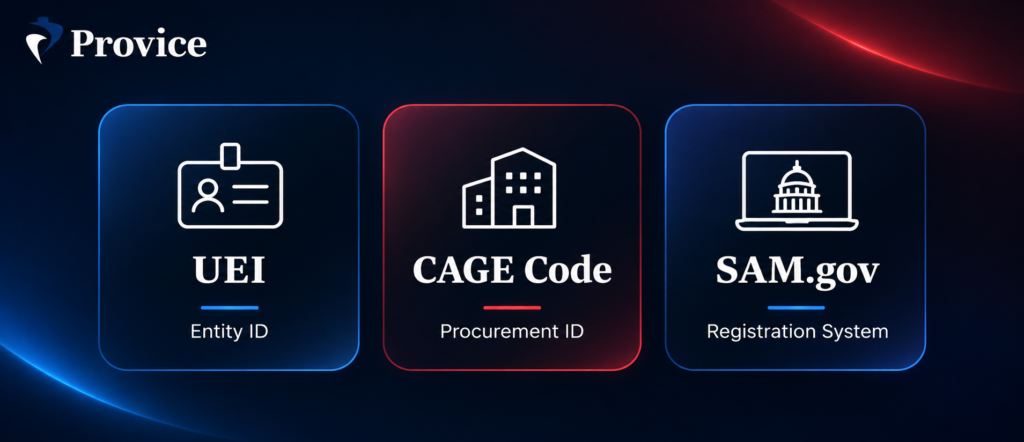
UEI vs CAGE Code vs SAM.gov: Comparison Table
| Feature | UEI | CAGE Code | SAM.gov |
| Full name | Unique Entity ID | Commercial and Government Entity Code | System for Award Management |
| What is it? | Entity identifier | Procurement-related identifier | Federal government system |
| Format | 12 alphanumeric characters | 5 alphanumeric characters | Website and registration database |
| Who manages it? | Assigned through SAM.gov | DLA CAGE program for U.S. entities | U.S. General Services Administration |
| Main purpose | Identifies an entity | Supports contractor identification and administration | Registers entities and manages federal award information |
| How is it obtained? | Through SAM.gov | Usually through federal registration processing for U.S. entities | By completing entity registration |
| Can it exist without active SAM registration? | Yes | Yes | An account or inactive registration may exist |
| Annual renewal? | No separate annual UEI renewal | No separate annual SAM-style CAGE renewal | Active registration must be renewed every 365 days |
| Does it alone make you ready to bid? | No | No | Active registration satisfies a key requirement, but other qualifications apply |
Let’s examine each in more detail.
What Is a Unique Entity ID (UEI)?
A Unique Entity ID, or UEI, is a 12-character alphanumeric identifier used by the U.S. federal government to identify an entity.
It is assigned through SAM.gov.
The UEI replaced the DUNS number as the federal government’s primary entity identifier in April 2022.
What is a UEI used for?
A UEI can be used to:
- Identify a business in federal systems.
- Support federal award registration.
- Connect an entity with federal contracting records.
- Identify organizations in certain federal assistance activities.
- Support subaward reporting and other federal transactions.
For example, a small IT consulting company entering federal contracting may receive a UEI during its SAM.gov registration process.
That UEI remains associated with the entity, even though its registration status may later change.
Do you need a SAM.gov registration to get a UEI?
No. You can obtain a UEI without completing full SAM.gov entity registration.
SAM.gov offers two relevant options:
Get a Unique Entity ID: For organizations that need an identifier but do not need to register directly for federal awards.
Register Entity: For organizations planning to bid directly on federal contracts or apply for other federal awards.
If your company only requests a UEI, it does not become fully registered for federal prime contracting.
Is a UEI free?
Yes. Obtaining a UEI through the official SAM.gov system is free.
You don’t need to pay a private company to obtain the identifier.
Does a UEI expire?
A UEI does not have the same annual renewal requirement as an active SAM.gov entity registration.
However, your business must keep relevant entity information accurate, and an active SAM.gov registration requires renewal every 365 days.
Key takeaway: A UEI identifies your business. It is not a certification, contract award, or substitute for active registration.
What Is a CAGE Code?
A Commercial and Government Entity (CAGE) code is a five-character alphanumeric identifier used in federal procurement and related government systems.
For entities located in the United States and its outlying areas, CAGE codes are assigned through the Defense Logistics Agency’s CAGE program.
Unlike a UEI, which identifies an entity, the CAGE system has a specific role in identifying commercial and government entities for procurement and administration.
What is a CAGE code used for?
CAGE codes can support:
- Contractor identification.
- Federal contract records.
- Contract administration.
- Certain payment-related systems.
- Contractor ownership and control information.
- Other federal acquisition activities.
For example, a construction contractor may have both a UEI and a CAGE code in its SAM.gov registration.
Federal contracting officials may use these identifiers when reviewing registration information or processing contract actions.
How do you get a CAGE code?
For U.S. entities, the process typically happens during SAM.gov entity registration.
If your business doesn’t already have a CAGE code, the applicable government process can assign one after you submit your registration information.
You do not generally need to purchase a separate CAGE code from a commercial registration provider.
Is a CAGE code the same as a UEI?
No.
A UEI and CAGE code serve different identification purposes.
They are separate identifiers, and businesses may need to provide both in federal contracting situations.
Does a CAGE code expire?
A CAGE code is not renewed annually in the same way as an active SAM.gov registration.
However, CAGE records must remain accurate, and relevant changes may require updates or validation.
Businesses should not confuse a CAGE code’s continued existence with active SAM.gov registration status.
Key takeaway: A CAGE code helps identify a contractor in federal procurement systems, but possessing one does not independently establish bidding eligibility.
What Is SAM.gov?
SAM.gov is the official U.S. government platform used for federal entity registration and other acquisition-related functions.
For small businesses, it serves as a central starting point for participating in federal prime contracting.
SAM.gov allows organizations to:
- Register for federal awards.
- Obtain a UEI.
- Maintain entity information.
- Complete required business representations and certifications.
- Update and renew registration.
- Review registration status.
- Search federal contracting opportunities.
Is SAM.gov registration mandatory?
For most federal prime contracting opportunities, businesses must have active SAM.gov registration at the required stages of the procurement.
Applicable Federal Acquisition Regulation provisions generally require registration when submitting an offer and at contract award, subject to exceptions and specific regulatory conditions.
This is different from simply having a UEI.
Is SAM.gov free?
Yes.
The federal government does not charge businesses to:
- Create a SAM.gov account.
- Obtain a UEI.
- Register an entity.
- Update registration information.
- Renew an entity registration.
Businesses may choose to purchase professional assistance with registration, but doing so is optional.
How often must SAM.gov registration be renewed?
Every 365 days.
Businesses should monitor their renewal dates and complete the process early enough to avoid interruptions in active status.
Does SAM.gov registration mean your company is qualified for every federal contract?
No.
A government solicitation may also require:
- Relevant experience.
- Professional licenses.
- Specialized certifications.
- Particular staffing qualifications.
- Financial resources.
- Technical capabilities.
- Small-business or socioeconomic eligibility.
- Security requirements.
- Other solicitation-specific qualifications.
An active registration establishes an important administrative foundation, not automatic eligibility for every opportunity.
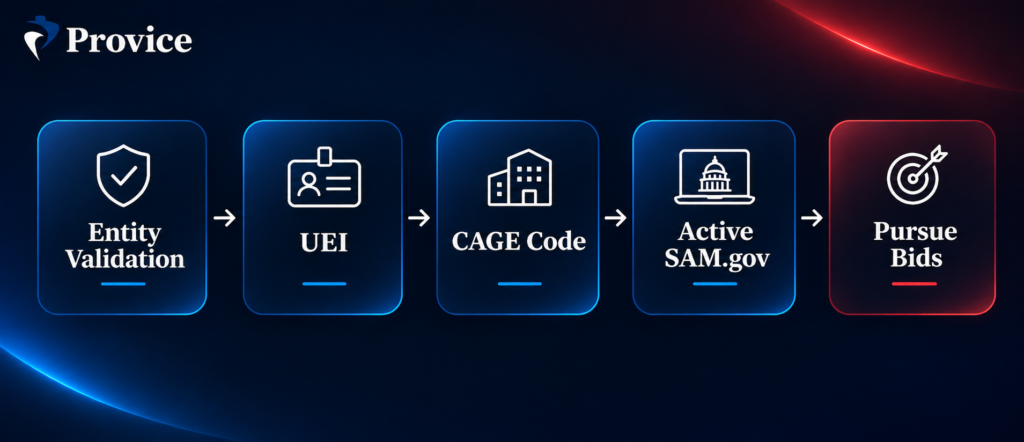
How UEI, CAGE Code, and SAM.gov Work Together
Consider a hypothetical small business called ABC Technology Solutions LLC.
The company wants to begin competing for federal IT consulting contracts.
Step 1: The company starts SAM.gov registration
ABC Technology Solutions visits the official SAM.gov website and selects the appropriate entity registration option.
Step 2: SAM.gov assigns a UEI
The system validates the company’s entity information and assigns its Unique Entity ID.
The UEI identifies ABC Technology Solutions in federal systems.
Step 3: The company completes its registration information
ABC enters required company, taxpayer, financial, NAICS, business assertions, and representations and certifications information.
Step 4: Its CAGE code is processed
If the U.S. company does not already have a CAGE code, the applicable government process can assign one as part of registration processing.
Step 5: The registration becomes active
Once the necessary validations and registration processing are complete, the business may achieve active SAM.gov registration.
ABC now has the relevant identifiers and an active registration record.
Step 6: The company begins pursuing opportunities
The company researches agencies, identifies relevant solicitations, and determines whether it meets each procurement’s eligibility and performance requirements.
The important distinction: Receiving an identifier is one step. Completing registration is another. Becoming competitive for government contracts requires additional preparation.
Do You Need All Three to Bid on Federal Government Contracts?
For most businesses pursuing federal prime contracts, the practical goal is to complete an active SAM.gov registration and maintain the identifiers associated with it.
Here’s how that applies in common situations.
| Business situation | What may be needed |
| Requesting an identifier for certain federal transactions | UEI only may be sufficient |
| Pursuing federal prime contracts | Active SAM.gov registration, including associated identifiers |
| Performing solely as a subcontractor | Depends on reporting, prime contractor, and subcontract requirements |
| Applying for federal financial assistance | UEI and applicable registration requirements |
| Bidding on state or local contracts | Requirements of the relevant government buyer |
| Operating outside the United States | Additional identification steps, potentially including an NCAGE code |
Always review the applicable transaction, agency instructions, and solicitation provisions.
What Is an NCAGE Code?
If your company is located outside the United States and its outlying areas, you may encounter the term NCAGE.
NCAGE stands for NATO Commercial and Government Entity.
It is the CAGE-related identification system used for qualifying organizations located outside the United States.
Foreign entities generally need to obtain an NCAGE code before beginning the full SAM.gov registration process.
This distinction matters for international businesses interested in U.S. federal contracting.
A foreign company’s federal registration process may differ from the process followed by a U.S.-based LLC or corporation.
Official resource: DLA CAGE Program
What About EIN and DUNS Numbers?
UEI and CAGE codes are also frequently confused with other business identifiers.
EIN vs UEI
An Employer Identification Number (EIN) is a federal tax identification number issued by the Internal Revenue Service.
A UEI identifies an entity in federal award systems.
These identifiers serve different purposes.
Having an EIN does not mean your business has a UEI or active SAM.gov registration.
DUNS vs UEI
The DUNS number was previously used as a federal entity identifier.
In April 2022, the federal government transitioned to the UEI for this purpose.
Businesses registering in SAM.gov today should follow current UEI requirements rather than seeking a new DUNS number for federal registration.
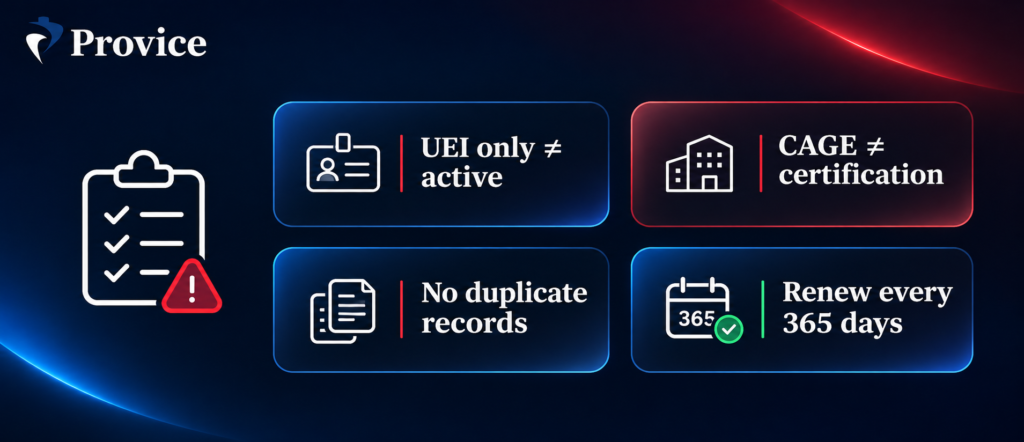
Common UEI, CAGE Code, and SAM.gov Mistakes to Avoid
Mistake 1: Assuming a UEI means your business is registered
Obtaining a UEI does not automatically activate federal entity registration.
Mistake 2: Confusing a CAGE code with a government certification
A CAGE code identifies an entity for procurement-related purposes. It is not an SBA 8(a), WOSB, HUBZone, or SDVOSB certification.
Mistake 3: Believing SAM.gov registration guarantees contracts
Government contract awards depend on the procurement process and the applicable evaluation and award criteria.
Mistake 4: Entering inconsistent legal business information
Differences between your registration information and official business or taxpayer records can create validation delays.
Mistake 5: Creating unnecessary duplicate entity records
Before beginning a new registration, determine whether your company already has a UEI or existing SAM.gov record.
Mistake 6: Forgetting SAM.gov renewal requirements
Your UEI and CAGE code may continue to exist while your SAM.gov registration becomes inactive.
Mistake 7: Paying unnecessary registration fees
The official government registration and UEI processes are free.
Professional assistance is optional, not a government requirement.
How to Check Your UEI, CAGE Code, and SAM.gov Registration Status
If your business has already registered, you can review its information through SAM.gov.
- Visit SAM.gov.
- Sign in through Login.gov.
- Open your Entity Workspace.
- Locate the relevant entity record.
- Review the UEI and available CAGE information.
- Confirm whether the registration status is active.
- Check the next renewal date.
If a registration is pending or inactive, review the official status information and determine what action is necessary.
SAM.gov also provides a registration status search for authorized users.
Practical tip: Maintain an internal registration record containing your UEI, CAGE code, registration status, renewal date, designated account administrators, and relevant vendor portal information.
Store sensitive account access information securely.
Frequently Asked Questions About UEI, CAGE Codes, and SAM.gov
1. Is a UEI the same as a CAGE code?
No. A UEI is a 12-character entity identifier assigned through SAM.gov. A CAGE code is a separate five-character identifier used in federal procurement and administration.
2. Can I have a UEI without a CAGE code?
Yes. An organization may obtain a UEI without completing full SAM.gov entity registration. This does not necessarily result in a CAGE code.
3. Can I have a CAGE code without an active SAM.gov registration?
Yes. A CAGE code can exist even when an entity does not have active SAM.gov registration. The existence of a CAGE code does not establish active registration status.
4. Is a UEI required for government contracts?
A UEI is generally part of the federal entity identification requirements for applicable federal awards. Requirements vary by procurement and transaction type.
5. How do I obtain a UEI?
Visit SAM.gov and choose either the UEI-only option or full entity registration, depending on your organization’s needs.
6. How do I get a CAGE code?
For U.S. entities registering for federal awards, a CAGE code is generally assigned or validated through the government registration process. Foreign entities normally follow NCAGE procedures.
7. Does a CAGE code mean I can bid on federal contracts?
No. Most federal prime contracting opportunities require active SAM.gov registration and compliance with additional solicitation requirements.
8. Is SAM.gov registration free?
Yes. The official federal entity registration and renewal process is free.
9. Do I need to renew my UEI every year?
No separate annual UEI renewal is required. However, active SAM.gov registrations must be renewed every 365 days.
10. What happens if my SAM.gov registration expires?
Your registration becomes inactive until the required renewal process is completed. This may affect your ability to satisfy federal procurement registration requirements.
11. Do subcontractors need a UEI or CAGE code?
Requirements depend on the subcontract, applicable federal reporting obligations, and prime contractor onboarding rules. Not every subcontractor needs full active SAM.gov registration.
12. Is an EIN the same as a UEI?
No. An EIN is a taxpayer identification number issued by the IRS, while a UEI identifies an entity in federal award systems.
13. Is a DUNS number still required for SAM.gov?
No. The federal government replaced DUNS with the UEI in April 2022.
14. Can a newly formed LLC obtain a UEI?
Yes. A newly formed LLC may obtain a UEI after completing the applicable entity validation process, provided it can supply the necessary information.
15. Can someone help me complete SAM.gov registration?
Yes. Businesses may use optional professional assistance for registration preparation, entity validation issues, documentation, and maintenance. The company should retain control of its accounts and ensure all submitted information is accurate.
The Bottom Line: Understand Your Identifiers Before Pursuing Federal Contracts
UEI, CAGE codes, and SAM.gov are connected, but each has a different role.
UEI identifies your business.
CAGE provides an additional procurement identifier.
SAM.gov is where your business completes and maintains federal entity registration.
For most small businesses pursuing federal prime contracts, active SAM.gov registration is an essential first step.
However, registration alone does not establish a successful government contracting strategy.
Your business still needs the right capabilities, market research, certifications where appropriate, qualified opportunities, and proposal preparation processes.
Understanding the differences between these registration components can help you avoid unnecessary delays and prepare for your next steps.
Need Help With UEI, CAGE Codes, or SAM.gov Registration?
Provice LLC helps small and growing businesses navigate government contracting registrations and build a stronger foundation for pursuing federal, state, and local opportunities.
Through our Certifications & Registrations service, we support businesses with:
- SAM.gov entity registration assistance.
- UEI setup and entity information review.
- CAGE and NCAGE registration coordination, as applicable.
- Entity validation and registration documentation.
- NAICS code identification.
- State and local vendor registration.
- Relevant certification support.
- Registration updates and renewal tracking.
For businesses entering government contracting for the first time, our GovCon Jumpstart solution can connect registration support with readiness assessments, opportunity sourcing, and initial bid preparation.
Getting registered is the first step. Building a repeatable contracting process is what comes next.
Your Business. Our Execution.
Official Government Resources
- SAM.gov — Entity Registration and UEI
- SAM.gov — Official Entity Registration Checklist
- Defense Logistics Agency — CAGE Program
- Acquisition.gov — FAR Subpart 4.18
- Acquisition.gov — FAR 52.204-7
- Federal Service Desk
Disclaimer: This article provides general educational information about federal entity identification and registration as of November 2026. Requirements may differ based on entity location, transaction type, applicable regulations, and individual solicitation instructions. Provice LLC is an independent business service provider and is not affiliated with or endorsed by SAM.gov, the General Services Administration, or the Defense Logistics Agency.