


Government Contracting | Provice LLC | Updated November 2026
Your company finds a government Request for Proposal (RFP) that looks promising.
The contract is in your industry. The estimated value looks attractive. Your team has experience providing similar services.
At first glance, it seems like an opportunity worth pursuing.
But after reviewing the solicitation, you discover that the agency requires specialized certifications, additional staffing, or past performance your company may not have.
Should you still submit a proposal?
This is where a government bid/no-bid decision becomes essential.
Many small businesses spend significant time preparing proposals for contracts they are not fully qualified to pursue—or cannot deliver profitably.
A structured bid/no-bid process helps businesses evaluate opportunities before committing staff, time, and resources.
In this guide, we’ll walk through a practical 15-point government bid/no-bid checklist, explain how to evaluate an RFP, and show you when to pursue, reconsider, or pass on a government contracting opportunity.
Quick Answer: What Is a Government Bid/No-Bid Decision?
A government bid/no-bid decision is a structured evaluation that helps a contractor determine whether a solicitation is worth pursuing.
The assessment considers eligibility, scope of work, past performance, technical capabilities, competitive positioning, staffing, pricing, financial capacity, and submission requirements.
Before bidding on a government RFP, ask five essential questions:
- Is our business eligible to compete?
- Does the work match our existing capabilities and experience?
- Do we have a realistic competitive advantage?
- Can we deliver the contract profitably and successfully?
- Can we submit a complete, compliant proposal before the deadline?
If the answer to a mandatory eligibility requirement is no, the business should generally not proceed without a legitimate way to resolve the issue under the solicitation’s terms.
If the opportunity passes the initial screening, a more detailed review can help determine whether the expected benefits justify the pursuit.
The goal is not to submit the most proposals. It’s to focus on opportunities your business has a credible chance of winning and delivering.
What Is a Bid/No-Bid Analysis in Government Contracting?
A bid/no-bid analysis is the process of reviewing a procurement opportunity before committing resources to proposal development.
It is usually conducted after identifying a potentially relevant opportunity but before beginning substantial proposal preparation.
For example, a small security company finds a solicitation for unarmed guard services at three municipal buildings.
The scope appears suitable, but the RFP also requires overnight coverage, specific insurance limits, and mobilization within 15 days.
Before bidding, the company should determine whether it can recruit the required personnel, meet licensing and insurance requirements, and deliver the services at a sustainable price.
If these requirements cannot be met, a decision not to bid may protect the company from unnecessary proposal expenses or future contract performance problems.
Why is a bid/no-bid process important?
A disciplined process can help businesses:
- Reduce time spent on unsuitable solicitations.
- Identify mandatory eligibility issues early.
- Improve proposal resource allocation.
- Evaluate competitive strengths and weaknesses.
- Avoid contracts with unacceptable operational or financial risks.
- Build a more focused government contracting pipeline.
A no-bid decision does not necessarily mean the opportunity lacks value.
Sometimes the contract may be better suited for a teaming arrangement, subcontracting role, or future pursuit.

The 15-Point Government Bid/No-Bid Checklist
Use the following checklist to evaluate an RFP before deciding to pursue it.
Part 1: Eligibility and Compliance
1. Does Your Business Meet the Solicitation’s Eligibility Requirements?
Start by identifying every mandatory eligibility condition.
These may include business size, set-aside status, certifications, licenses, registration requirements, and other procurement-specific qualifications.
Check:
- Is the solicitation unrestricted or set aside for a specific business category?
- Do we meet the applicable small-business size standard?
- Are required professional licenses or certifications current?
- Does the opportunity require access to an existing contract vehicle?
- Are there restrictions affecting our ability to compete?
For example, an opportunity reserved for eligible service-disabled veteran-owned small businesses generally cannot be pursued as a qualifying SDVOSB prime contract by a company that lacks the required status.
Decision: If your company cannot satisfy a mandatory condition, treat the issue as a potential disqualifier rather than simply a weakness in your proposal.
2. Is Your SAM.gov or Other Vendor Registration Ready?
For most federal prime contracting opportunities, an active SAM.gov registration is required when submitting an offer and at award, subject to applicable exceptions.
State and local government solicitations may impose separate vendor registration requirements.
Check:
- Is our applicable registration active?
- Does the registration reflect the correct legal entity?
- Are required identifiers and representations accurate?
- Do we meet any registration deadlines established by the solicitation?
A pending registration should not automatically be treated as satisfying a requirement for active status.
For additional guidance, read our related article: 5 SAM.gov Mistakes That Can Delay Your Ability to Bid.
3. Can You Meet Every Mandatory Contract Requirement?
A company may be eligible to compete but unable to meet specific performance conditions.
Review the complete solicitation, including the Statement of Work (SOW), Performance Work Statement (PWS), attachments, amendments, and applicable contract terms.
Check:
- Required licenses and insurance.
- Security clearances or personnel qualifications.
- Mandatory equipment and facilities.
- Service locations.
- Delivery schedules.
- Contract-specific reporting and compliance obligations.
Distinguish between mandatory requirements and factors that can be addressed through your proposed technical approach.
Decision: If a requirement is mandatory and you cannot satisfy it, do not rely on an otherwise strong proposal to compensate.
Part 2: Scope and Technical Capability
4. Does the Scope Match Your Core Services?
A solicitation may contain keywords related to your industry without actually purchasing the services your company specializes in.
For example, an IT staffing company might find a solicitation titled “IT Support Services.”
However, the detailed scope may require managing an entire help desk rather than supplying IT professionals.
These are different business models with different responsibilities and risks.
Check:
- Does the contract involve services we currently deliver?
- Are the technical requirements consistent with our expertise?
- Does the work involve substantial unfamiliar responsibilities?
- Would we need to develop entirely new capabilities to perform?
Provice tip: Evaluate the actual deliverables, not just the solicitation title or NAICS code.
5. Do You Have Relevant Past Performance?
Government buyers may assess previous projects to determine whether a contractor has demonstrated the ability to perform similar work.
The importance and acceptability of past performance depend on the solicitation.
Check:
- Do we have projects comparable in scope and complexity?
- Are those projects recent enough to satisfy the requirements?
- Can we provide supporting documentation?
- Are relevant customer references available?
- Does the solicitation accept commercial or subcontracting experience?
A company without federal contract history is not automatically disqualified from every opportunity.
However, if a solicitation establishes specific experience requirements, those conditions must be evaluated carefully.
6. Do You Have the Staffing and Operational Capacity?
Winning a contract creates delivery responsibilities.
Before bidding, determine whether your organization can meet the workload without compromising existing commitments.
Check:
- How many employees will be required?
- Are specialized personnel needed?
- Can we recruit or mobilize staff within the required period?
- Will the work require additional supervisors, equipment, or subcontractors?
- Can existing operations support the new contract?
For example, a staffing firm may be qualified to provide 10 temporary employees but lack the resources to mobilize 200 employees across multiple states within two weeks.
The contract may be attractive, but the delivery risk could outweigh its potential value.
Part 3: Competitive Position and Market Intelligence
7. Do You Understand the Government Customer?
Knowing who issued the solicitation is not the same as understanding what the buyer needs.
Research the agency, purchasing history, and relevant programs.
Check:
- Has the agency purchased similar services before?
- What problems is the requirement intended to solve?
- Are there previous contracts related to this requirement?
- Is the work new, recurring, or replacing an existing arrangement?
- Do we understand the buyer’s stated priorities?
Historical federal awards can be researched through USAspending.gov.
A better understanding of the customer can help you evaluate whether your business has a meaningful reason to compete.
8. Do You Understand the Competitive Landscape?
Government solicitations may attract multiple qualified contractors.
Before pursuing an RFP, consider the likely competition.
Check:
- Is there an incumbent contractor?
- Does the incumbent have significant relevant experience?
- Are there many established competitors in this market?
- Does our company offer a meaningful differentiator?
- Can we demonstrate that advantage within the solicitation’s evaluation framework?
An incumbent does not automatically win a recompete, and the absence of an incumbent does not guarantee limited competition.
However, competitive research helps businesses understand the likely challenges.
9. Can You Build a Strong Proposal Against the Evaluation Criteria?
Even when your company is qualified, it must demonstrate that qualification in the format required by the government.
Review the stated evaluation factors and their relative importance where provided.
These may involve:
- Technical approach.
- Management and staffing.
- Relevant experience.
- Past performance.
- Price or cost.
- Other procurement-specific factors.
Check:
- Can we provide convincing evidence for each evaluation factor?
- Do we have the necessary supporting information?
- Are there important weaknesses in our response?
- Can our team explain a clear approach to performing the work?
Provice tip: A strong proposal should address the government’s actual evaluation criteria rather than simply describing your company’s general strengths.
Part 4: Financial and Delivery Feasibility
10. Can You Price the Contract Profitably?
Revenue potential does not automatically make a government contract financially attractive.
Before deciding to bid, estimate the full cost of performance.
Consider:
- Direct labor.
- Payroll taxes and benefits.
- Applicable wage requirements.
- Equipment and materials.
- Insurance.
- Recruiting and training.
- Travel.
- Subcontractor costs.
- Contract administration.
- Overhead.
- Contingencies and profit.
For example, a security company might offer a highly competitive hourly rate but fail to include overtime, supervision, insurance, and employee benefits.
The result could be a contract with insufficient margin to support delivery.
Decision: Do not pursue a contract at a price your company cannot sustainably deliver.
11. Can Your Business Support the Cash Flow Requirements?
Government contracts may require contractors to incur costs before receiving payment.
Labor-intensive contracts can create particular challenges.
Check:
- Can we cover payroll before receiving customer payments?
- Are significant upfront purchases necessary?
- Is financing available if needed?
- Have we reviewed the payment terms?
- Can our business absorb reasonable payment delays or unexpected costs?
A contract can be profitable on paper but still create serious cash flow pressure.
12. Are the Contract Terms and Performance Risks Acceptable?
Review the obligations your business would assume if awarded the contract.
Check:
- What performance standards apply?
- Are liquidated damages or other financial consequences specified?
- Are there unusual insurance or indemnification requirements?
- How are changes and disputes handled?
- Are there substantial subcontracting or reporting obligations?
- Does the contract require a performance or payment bond?
The applicable terms depend on the solicitation.
A contract with strong revenue potential may still present unacceptable operational or contractual risk.
Part 5: Proposal Effort and Strategic Fit
13. Is There Enough Time to Prepare a Compliant Proposal?
A short deadline can make an otherwise suitable opportunity difficult to pursue.
Check:
- How much time remains before submission?
- Is a mandatory site visit required?
- Has the deadline for questions passed?
- Can we obtain pricing from suppliers or subcontractors?
- Are technical documents and references available?
- Do we have time for a final compliance review?
Submitting an incomplete proposal simply to meet a deadline may be a poor use of resources.
14. Do You Have the Internal Resources to Manage the Bid?
Government proposals often require contributions from multiple people.
These may include management, operations, finance, human resources, technical staff, and external partners.
Check:
- Who will lead proposal development?
- Who will prepare the technical response?
- Who will develop pricing?
- Who will review compliance?
- Who will approve the final submission?
If the proposal process would significantly disrupt ongoing operations, consider whether the opportunity justifies that cost.
15. Does the Opportunity Support Your Business Growth Strategy?
A contract may be technically suitable but strategically unattractive.
Consider how the opportunity fits your company’s longer-term priorities.
Check:
- Does it strengthen our core service offerings?
- Does it open a valuable government market?
- Can it support future past performance?
- Does it create a useful customer or prime contractor relationship?
- Would pursuing it distract from more attractive opportunities?
A smaller contract closely aligned with your company’s strategy may offer more long-term value than a larger, higher-risk opportunity.
Government Bid/No-Bid Scorecard: How to Evaluate an RFP
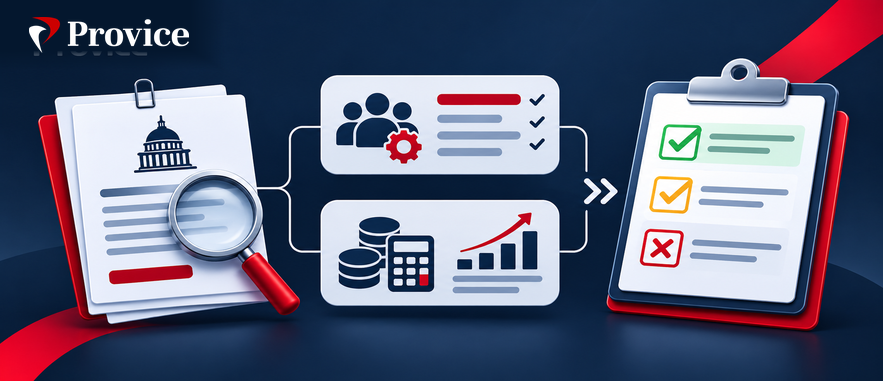
Use the 15 questions above to create a practical internal decision score.
For each item, assign:
- 0 points: Not ready or substantial weakness.
- 1 point: Partially ready or issue requires verification.
- 2 points: Ready, supported by evidence, and aligned with the requirement.
The maximum score is 30 points.
| Evaluation area | Maximum points |
| Eligibility and compliance (Questions 1–3) | 6 |
| Technical capability (Questions 4–6) | 6 |
| Competitive position (Questions 7–9) | 6 |
| Financial feasibility (Questions 10–12) | 6 |
| Proposal resources and strategy (Questions 13–15) | 6 |
| Total | 30 |
How to Interpret Your Score
| Score | Suggested decision |
| 25–30 | Strong pursuit candidate |
| 19–24 | Conditional pursuit — resolve important gaps first |
| 13–18 | High-risk pursuit — consider alternatives or teaming |
| 0–12 | Generally not recommended without major changes |
Important: This is a suggested Provice planning framework, not an official government evaluation method or a statistically validated prediction of award success.
A high score does not override a mandatory eligibility requirement.
Likewise, meeting all mandatory requirements does not mean a company has a strong competitive position.
Use the score as a structured discussion tool, not as the sole basis for deciding whether to bid.
When Should You Automatically Consider a No-Bid Decision?
Certain issues should trigger an immediate pause.
Examples include:
- Your company does not meet a mandatory set-aside or eligibility condition.
- Required licenses or qualifications are missing and cannot be obtained in time.
- The contract requires capabilities your business cannot provide.
- Mandatory submission requirements cannot be completed.
- The financial model indicates an unsustainable price.
- You cannot mobilize the required resources.
- The performance risk is unacceptable.
- A mandatory site visit or deadline has already been missed.
Some issues may be resolved through a permitted teaming arrangement, subcontracting structure, or timely clarification.
However, a partner does not automatically cure every eligibility or qualification problem.
The solicitation and applicable contracting rules determine what arrangements are permitted.
Example: Should a Small Security Company Pursue This RFP?
Consider a hypothetical security company reviewing an unarmed guard services solicitation.
The agency needs guards at three government buildings.
The company already provides similar services and holds the required local licenses.
However, the solicitation also requires overnight coverage and a short mobilization period.
Initial Evaluation
| Evaluation factor | Finding | Assessment |
| Eligibility | Required licenses are current | Strong |
| Scope | Services match existing capabilities | Strong |
| Past performance | Similar contracts completed | Strong |
| Staffing | Additional overnight guards required | Needs verification |
| Financial capacity | Payroll capacity appears sufficient | Strong |
| Pricing | Overtime assumptions need review | Needs verification |
| Proposal deadline | Enough preparation time remains | Strong |
Recommended Decision: Conditional Pursuit
The company should not immediately reject the opportunity.
However, before committing to proposal development, management should verify recruitment capacity, overnight staffing arrangements, and total labor costs.
If these concerns can be resolved within the solicitation’s requirements, the business may have a credible pursuit.
If not, declining the bid could be the more responsible decision.
The lesson: A good bid/no-bid process identifies issues early enough to make an informed choice.
How to Make Bid/No-Bid Decisions More Consistently
Many contractors evaluate opportunities informally.
One team member finds a bid, another reviews the scope, and management decides whether it looks attractive.
This can work occasionally, but as the pipeline grows, inconsistent decisions become costly.
A repeatable process should include:
Opportunity intake: Record the agency, solicitation number, deadline, estimated value if available, and primary scope.
Initial eligibility review: Check mandatory requirements before conducting extensive research.
Technical and financial review: Confirm delivery capabilities, pricing assumptions, and contract risks.
Competitive assessment: Evaluate customer familiarity, incumbent information, and differentiators.
Decision approval: Assign a responsible manager to approve pursue, verify, or pass decisions.
Decision documentation: Record the reasoning so your team can improve future evaluations.
A centralized CRM, spreadsheet, or bid tracker can help maintain this information.
The specific technology matters less than having a consistent process.
Frequently Asked Questions About Government Bid/No-Bid Decisions
What is a bid/no-bid checklist?
A bid/no-bid checklist is a structured set of questions used to determine whether a company should pursue a procurement opportunity. It evaluates eligibility, capabilities, competition, pricing, risk, and proposal resources.
When should you conduct a bid/no-bid analysis?
The initial analysis should occur after reviewing a potentially relevant solicitation and before committing substantial resources to proposal preparation. Revisit the decision when amendments or new information materially change the opportunity.
What factors are most important in a government bid/no-bid decision?
Mandatory eligibility, scope alignment, relevant experience, delivery capacity, competitive positioning, pricing, and financial risk are among the most important considerations. The weight of each depends on the solicitation.
Should a small business bid on every government contract it qualifies for?
No. Being eligible does not automatically make an opportunity commercially attractive. Businesses should assess whether they can compete effectively and deliver the work at an acceptable level of risk.
Can you bid without previous government contract experience?
Sometimes. Requirements vary by solicitation, and relevant commercial or subcontracting experience may be considered. Review the actual qualifications and evaluation criteria.
Does the lowest bidder always win a government contract?
No. Government solicitations use different evaluation approaches. Some emphasize lowest-priced technically acceptable offers, while others permit tradeoffs or use different award methods. The solicitation establishes the applicable evaluation criteria.
Can a subcontractor help a business qualify for an RFP?
Potentially, if the solicitation and applicable rules permit the arrangement. However, subcontractors do not automatically satisfy prime-contractor eligibility, certification, experience, or other mandatory requirements.
Should you bid if the proposal deadline is only a few days away?
Only if your business can meet every applicable requirement and submit a complete, compliant response on time. A short deadline should trigger a careful resource and compliance assessment.
What is a good bid/no-bid score?
There is no universally accepted numerical score. Companies may establish internal scoring systems, but mandatory eligibility and commercial judgment should take precedence over a total score.
What should happen after a no-bid decision?
Document the reason. If the opportunity is strategically important, consider whether a future procurement, permitted teaming arrangement, or subcontracting role may offer a better fit.
Winning More Government Contracts Starts With Choosing the Right Ones
Government contracting success is not determined by the number of proposals a business submits.
It depends on identifying opportunities that align with the company’s capabilities, preparing competitive responses, and delivering contracts successfully.
A structured bid/no-bid process helps businesses avoid unnecessary proposal expenses, recognize risks, and focus their resources where they are most useful.
Before pursuing your next RFP, examine the scope, qualifications, evaluation criteria, delivery requirements, financial implications, and competitive environment.
The right decision isn’t always to bid. Sometimes the most valuable decision is knowing when to pass.
Build a More Focused Government Contracting Pipeline With Provice
Finding a government opportunity is only the beginning.
Turning that opportunity into a competitive, compliant proposal requires research, qualification, planning, coordination, and execution.
Provice LLC helps small and growing government contractors manage these activities through our 360° Capture & Bid Management service.
Depending on your company’s needs and engagement scope, our team can support:
- Government opportunity sourcing and qualification.
- Bid/no-bid analysis.
- Agency and market research.
- Capture planning and pursuit coordination.
- Solicitation and compliance reviews.
- Proposal preparation and technical response coordination.
- Pricing coordination.
- Required documentation and submission preparation.
- Bid pipeline management and follow-up tracking.
Rather than treating every solicitation as an isolated proposal, Provice helps businesses establish a more organized process for evaluating, pursuing, and responding to government opportunities.
Whether you’re managing multiple opportunities or trying to improve your bid selection process, the goal is to focus your resources on contracts that make sense for your business.
Choose the right opportunities. Build stronger proposals. Create a more consistent contracting process.
Explore Provice’s 360° Capture & Bid Management service.
Your Business. Our Execution.
Official Government Resources
- SAM.gov — Contract Opportunities
- Acquisition.gov — FAR 15.304, Evaluation Factors
- Acquisition.gov — FAR 15.305, Proposal Evaluation
- Acquisition.gov — FAR 52.204-7, SAM Registration
- SBA — Federal Contracting
- USAspending.gov
Disclaimer: This article provides general educational guidance for evaluating government contracting opportunities. The checklist and scorecard are business-planning tools and do not establish procurement eligibility or predict contract awards. Always review the current solicitation, applicable amendments, and governing requirements before submitting a response.